
Toward a Conceptual Model of Crowdsourcing
07 March 2013
A recently published paper produced by various authors from the University of Nebraska in Omaha aims to review the existing literature of crowdsourcing (defined as "a collaboration model enabled by people-centric web technologies to solve individual, organizational, and societal problems using a dynamically formed crowd of people who respond to an open call for participation").
Based upon their survey, they provide a conceptual model "for guiding future studies of crowdsourcing" that has the following components: Problem, People (Problem Owner, Individual, and Crowd), Governance, Process, Technology, and Outcome (figure below).
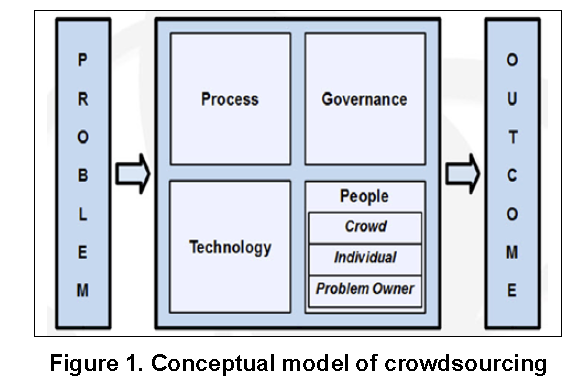
The authors acknowledge that this just a first step toward "a Theory for Analyzing, useful for classifying and summarizing discrete findings". Perhaps more importantly are the gaps the authors identified in existing research. Using the model they list a set of areas were more study is required. For instance, as to the "people" component:
"More insight is needed into what drives [problem owners] to consider crowdsourcing, as well as their positive and negative experiences with this approach. The rapidly expanding use of crowdsourcing provides clues, but more hard evidence is needed. The individual is also a key member of the crowdsourcing solution, and more research into what motivates them is important. Better understanding of motivation in terms of intrinsic vs. extrinsic motivators, how best to mix them, how that varies with problem type, and how those motivators affect composition of the crowd is needed. More knowledge about this crowd, the collective group of individuals, is needed as well. Their needs vary from problem to problem, based primarily on the problem type and governance employed, but little is known definitively in this area. Trust and privacy issues need additional research as well."
