
The Finance Innovation Lab – A Strategy for Systems Change
19 May 2016
In the wake of the financial crisis of 2008, the effects of which are still being felt today, how can innovators from both sides of the financial system work toward reform?
Last Monday as part of The GovLab’s Ideas Lunch series, Rachel Sinha from The Finance Innovation Lab in the UK tackled this question head-on. Her organization brings together innovators from a variety of sectors, including civil society groups, government, business and mainstream financial firms, all determined to transform current financial systems for the good of society.
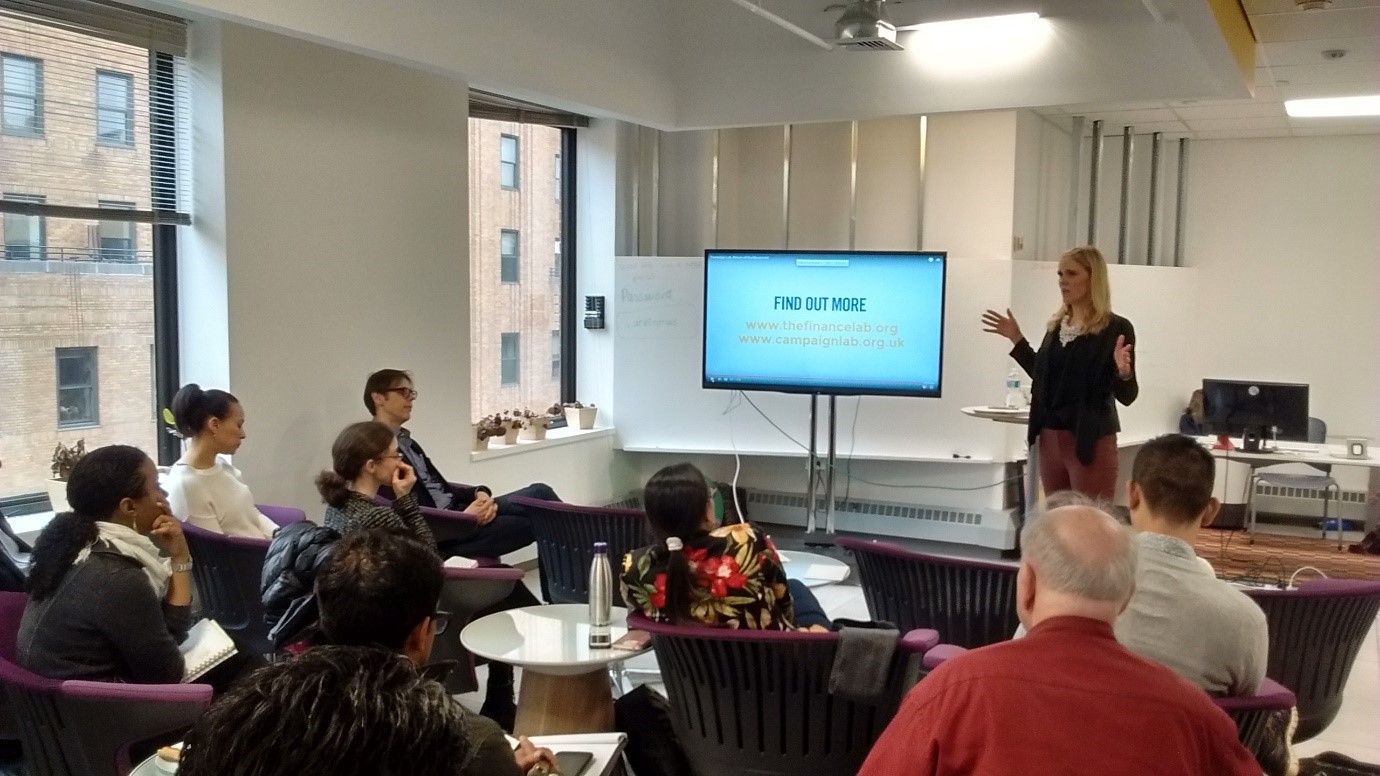
In essence, The Finance Innovation Lab tries to capture the revolutionary spirit which emerged following the financial crisis in order to build communities to create change in practical and scalable ways. Sinha highlighted that this process of networking and community building was key to creating collaborative solutions to tackle large, imbedded problems within finance and other sectors.
The Financial Innovation Lab developed as a partnership between the World Wildlife Fund (WWF) and the Institute of Chartered Accountants. Despite their disparities, the two organizations were united by a common desire to create a more sustainable and democratic financial system, one that takes into account the needs of both people and the planet. The idea was to build upon this momentum for change to crowdsource ideas from within the financial system and develop these into implementable projects. The Financial Innovation Lab emerged to workshop and create these projects to lead to financial reform in the UK.
During her presentation, Sinha explained how she and the team behind the Finance Innovation Lab had to innovate their own organization before confronting innovation in the financial sector. By focussing on their strengths—in generating networks of motivated people, fostering conversations between activists within and outside of the finance sector, and empowering citizens—her team was able to better articulate the Finance Innovation Lab’s mission and harness their leadership potential in order to generate change. As a result, projects such as the Campaign Lab, a program which supports economic justice campaigners, have grown to be independent sites of change and innovation.
3 components of campaign lab: Build community, create systemic strategies, build leadership @RachelmSinha pic.twitter.com/voZoFOaSbu
— The GovLab (@TheGovLab) May 2, 2016
Key Takeaways
- Concentration of influence and power makes change difficult
The biggest barrier to change, explained Sinha, are concentrated centres of influence and power, which are often distant from the communities demanding reform. This can make transforming the status-quo seem like an unsurmountable task. But, by identifying these centres of power, and engaging these sectors in open dialogue with communities and civil society groups, Sinha suggested it was possible to crowdsource ideas from those in power to spur change from within the system.
- In order to create change, we have to “think systemically”
Sinha argued that change is never achievable if actors are not organized as a system. By thinking systematically—uniting people together to solve a problem, and leveraging existing communities—the spirit for change becomes a strategized and effective system capable of creating reform. As Sinha suggested, movements for change should “not just preach to the choir, but organize the choir.”
- Four Steps toward Reform and Innovation: Amplify, Demonstrate, Reform and Scale
Sinha outlined the 4 steps which formed a strategy for innovation, which is used by the Finance Innovation Lab to design and develop projects.
- Amplify: This involves bringing together diverse groups and building upon their ideas for change through dialogue and networking.
- Demonstrate: It is not simply enough to convene, but innovation leaders also need develop new tools and ways to function, and showcase improvements from these measures to reform. This is fundamental in creating a sustainable strategy for innovation.
- Reform: Leaders must be strategic about what areas can be changed, and where to target their efforts. By being specific, and understanding limitations, reform can be more implementable and effective.
- Scale: It is important to build strategies as the project grows, ensuring it remains dynamic and adaptable.
By building upon these core principles, the Finance Innovation Lab has become a space where radical ideas are created, articulated and developed so that perceptible change can take place. For Sinha, a key example of this iterative approach toward reform is the AuditFutures project. Launched by the Finance Innovation Lab, this project challenges existing approaches to accounting by running workshops and programmes to encourage practicing and future auditors to think about the social impact of their work.
In such a way, the Finance Innovation Lab has launched a variety of projects—some that falter, and others that flourish—to nurture innovation and radical reform in a variety of sectors of the finance community.
About Rachel Sinha
Rachel Sinha is a British award winning social innovator. She co-founded The Finance Innovation Lab with four other team members, and was named by the Guardian newspaper as one of 50 Radicals ‘changing the face of the UK for the better’. Sinha is an established thought leader in the field of social innovation and systems change and the co-author of Labcraft, a book on social Labs. She has written for publications including HBR and Fast Company, documented the work of systems leaders with Oxford University as well as published her experiences of running a Lab in A Strategy for Systems Change.
About the Financial Innovation Lab
The Finance Innovation Lab, first convened by The Institute of Chartered Accountants and the World Wildlife Fund, brought together accountants, activists, investors and citizens to work on transforming the future of finance. It launched several successful organizations as part of the strategy, from an accelerator program for economic justice campaigners (Campaign Lab), to a Rockefeller Foundation and World Bank funded ‘Natural Capital Coalition’ with a protocol for business to account for natural capital.
