
Is Crowdsourcing the right tool for your project?
20 October 2014
An expert system approach to knowledge management and expertise sharing
Generally speaking, crowdsourcing is the process in which an individual, an institution, or an organization proposes to another group of individuals the voluntary undertaking of a participative online activity. Through crowdsourcing governments and organizations have effectively leveraged the collective intelligence of online communities to serve business goals, improve public participation in governance, strengthen and facilitate citizen participation in government, design products, and even solve complex problems (ranging from tackling corruption and combating urban crime to accelerating scientific analysis to cure cancer).
A little over a year ago, Beth Noveck challenged our NYU-Wagner Capstone team to come up with a method to help decision-makers in the public and private sectors make informed decisions about when and how to use crowdsourcing and thus enable institutions and individuals to leverage the wisdom of the crowd.
But as our research deepened, we discovered dozens of different definitions and examples. The complexity of the task became clear. The abundance and disorganization of proliferating crowdsourcing examples and literature reminded us of the two-thousand-years-old concern raised by the philosopher Seneca in a dialog with his friend Annaeus Serenus:
“…What is the use of having countless books and libraries, whose titles their owners can scarcely read through in a whole lifetime? The learner is, not instructed, but burdened by the mass of them…”
Having gathered hundreds of case-studies, we found a lack of conclusive evidence of what kind of crowdsourcing is best and under what circumstances to achieve different objectives. How could we know better what works? How might we design a system whereby the reader could find only those examples and case studies most relevant to his or her specific needs and circumstances?
Expert Systems
Our inquiry led us to David R. Johnson, a lawyer and law professor specialized in computer communications then a Senior Fellow at the Center for Democracy and Technology, who introduced us to expert systems. Expert systems are one of the first forms of artificial intelligence that evolved in the late 1960s as an attempt to emulate the problem-solving abilities of a human expert using a set of rules and inferences programmed into a computer system.
Expert systems today can be created as long as there is expertise that can translate into a specific set of rules or reasoning (for example: if/then rules; decision trees, etc) and are significantly easier and less costly to build and maintain than at the time when they first appeared in the market.
Applications of expert systems exist in areas as diverse as medicine, construction, geology and meteorology. Expert systems can generally be used to give advice, trace patterns of logic employed in decision-making, predict events, diagnose problems, design possible scenarios and monitor developments among others. Find out more about expert systems HERE.
We first collected a broad database of case-studies and developed a set of specific guidelines that outlined the basic elements that need to be taken into consideration when designing a crowdsourcing project. We then attempted to capture this knowledge into a specific set of rules and case-base reasoning.
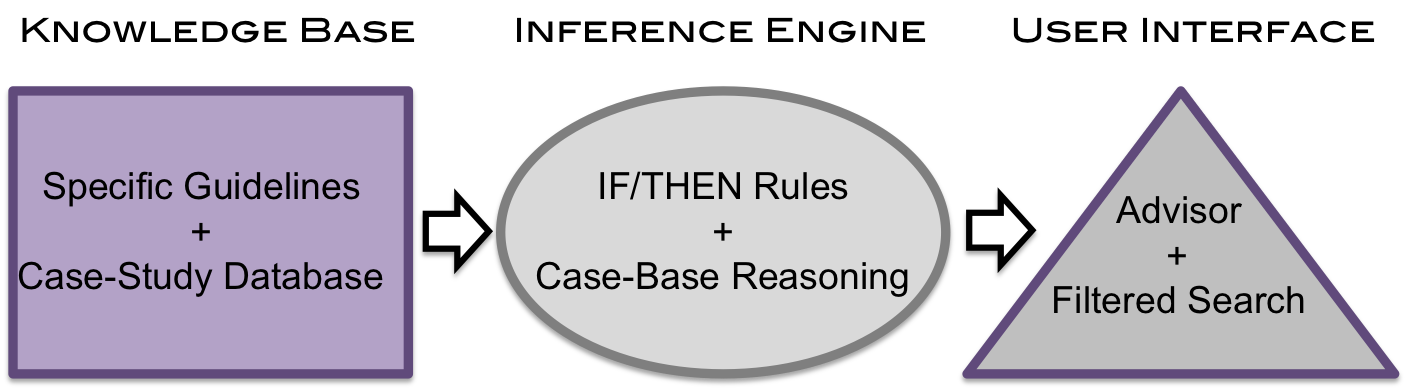
The Crowdsourcing Design Advisor
The Crowdsourcing Design Advisor starts from the proposition that there is no one way of “doing crowdsourcing” but, rather, knowledge must be tailored to a given project’s specific needs and circumstances. Under the assumption that similar problems have similar solutions, we have attempted to help decision-makers in the public and private sector make informed decisions about when and how to use crowdsourcing by provisioning them with examples and case studies of what others have done in similar circumstances.
How does it Work?
- The Interview: Through a 5-minute guided interview the Advisor walks you through a series of questions designed to understand your specific needs and circumstances.
- The Report: The tool uses your answers to the questions to automate the production of a report that draws relevant information from a repository of several hundred case-study examples housed on the GovLab Knowledge Base.
The hope is that any government official, project manager, organizer or citizen interested in creating new processes and spaces for engagement and collaboration through crowdsourcing, could make use of the advisor to find instructive case studies of when others have used crowdsourcing when faced with similar project objectives and intended audience, Since there are no best practices, they might find comparables to their circumstances to inform how they design their own.
Next Steps for the Crowdsourcing Design Advisor
We are currently developing the webpage that will host the advisor and will also serve as an open-source data repository on crowdsourcing that will support evidence-base answers to the question of when and how crowdsourcing works best.
Become part of our Crowdsourcing Research Team: we are currently forming partnerships with individuals and institutions with the goal of co-creating a continuously growing database of tools and case-studies. From the research perspective our ultimate objective is to build a large data set structured to organize high quality comparative information on crowdsourcing.
Please contact me if you would like to join our team: dinorah@thegovlab.org
**Special thanks to Sarah Chan and Gray O’Byrne, who already joined the team and are focusing on case studies on the Government of Canada, and Irene Tello Arista, who is volunteering part-time for the project.
***The first prototype of the advisor was designed by these members of the Wagner School of Public Service, Class of 2014: Naomi Adland; Naomi Berlin; Dinorah Cantú-Pedraza; Marisse del Olmo-Crenier; Hallie Martin; and Chandan Sharma. This advisor was created with the Neota Logic expert system development platform.
