
Chelsea Mauldin: How the Public Policy Lab uses design thinking to create better policies
16 December 2014
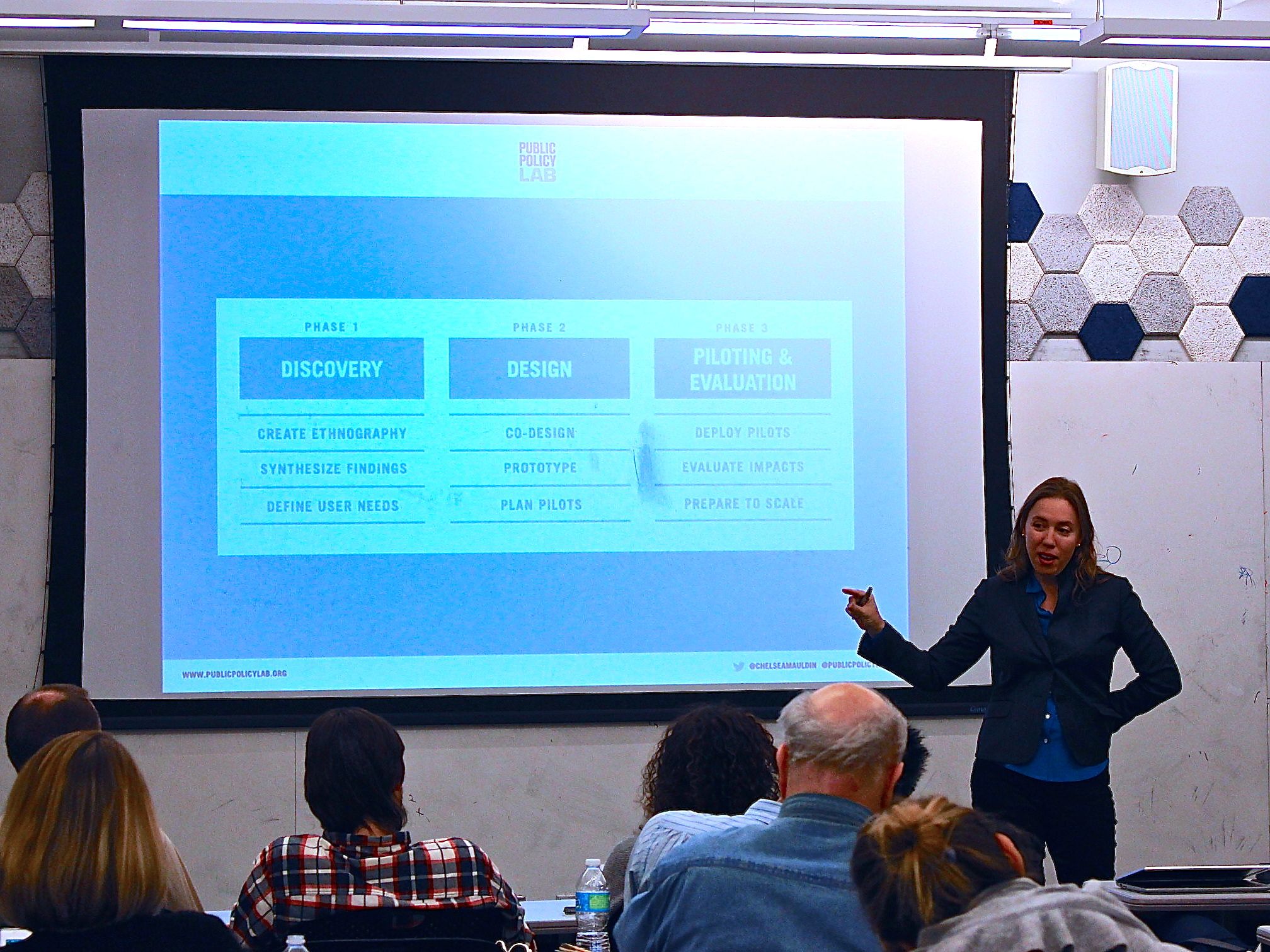 Over the past few years, policy innovators have made an effort to move past traditional top-down policymaking and rethink how to improve public services by applying principles of design thinking. At the latest GovLab Ideas Lunch, Chelsea Mauldin, executive director of the Public Policy Lab, shared her experience using collaborative design strategies to tackle major public policy problems.
The Public Policy Lab launched in 2011 as a non-profit organization with a mission to “create better public services for all Americans by changing the way public policy is created and implemented.” In an innovative approach to policy design, Mauldin and her colleagues at the Public Policy Lab pursue strategic working partnerships with government agencies. During this collaboration, selected agency employees are embedded within the Public Policy Lab’s team of designers. This working partnership helps increase team capacity and effectiveness while also promoting buy in within the agency, making it more likely that the project will be continued and scaled.
Guiding the overall policy design process is a dedication to a user-centered design perspective that defines all phases of work, starting with discovery, then moving to design, piloting and evaluation. Mauldin and her team strongly support the idea that the entire experience – that is every step a user takes – from thinking about taking an action to receiving services – is an opportunity for new kinds of design that can optimize the overall user experience and contribute to better, more effective policies.
To provide real world examples, Mauldin highlighted two case studies of projects recently executed by the Public Policy Lab:
Case #1: The Department of Housing Preservation and Development (HPD)
- HPD is a department within the municipal government of New York City that is responsible for developing and maintaining the stock of affordable housing. The Public Policy Lab partnered with HPD and a research lab at Parsons to evaluate who the users are and what their experience is. Next, through a collaborative design process with key stakeholders including applicants, housing developers, marketers, and agency employees, Mauldin’s team developed four proposals that represent an optimal user journey in applying for affordable housing through the agency. These proposals were piloted tested and results were released publicly, showing the team’s designs improved understanding and decisonmaking in the application process.
Case #2: Services for High Need Students
- The Public Policy Lab was tasked by the NYC Department of Education with improving a complex service for high need students. By incorporating the family members of the students, service providers, and school staff in the design process, Mauldin and her team were able to develop plans for nine potential projects that represented new interaction models with the families. The selected projects led to the development of three new service models, along with prototypes for hard-copy tools to help facilitate service delivery. Currently, the DOE is determining the feasibility of implementing this project on a small scale for testing purposes.
In working through these projects at the Public Policy Lab, Mauldin says that policy designers must work together to solve following mysteries:
- It is critical to understand the complexity of the service delivery system by mapping all stakeholders involved and their competing requirements and needs.
- Designers must understand the mandate given to a particular agency, and what kind of tax dollars are available for specific services.
- Designers should learn about the institutions themselves and how they operate on a day to day basis (for example understanding procurement processes and timelines).
- Policy designers must understand the culture within the agencies, and the openness to collaboration and experimentation.
Mauldin concluded the lunch with the idea that there should be a movement within government to “recognize designers as inventors, and create opportunities to creatively generate solutions to complex problems.” By looking at the past two years of experimentation at the Public Policy Lab, it is clear that codesign and user-centric design thinking can lead to innovative, effective and scalable policies.
For more information on the Public Policy Lab’s work, please visit the following links:
Designing Services for Housing
Evaluating New Housing Services
The School Choice Experience
Check out the GovLab Wiki to learn more about design thinking.
