
Making Room for Justice
17 March 2016
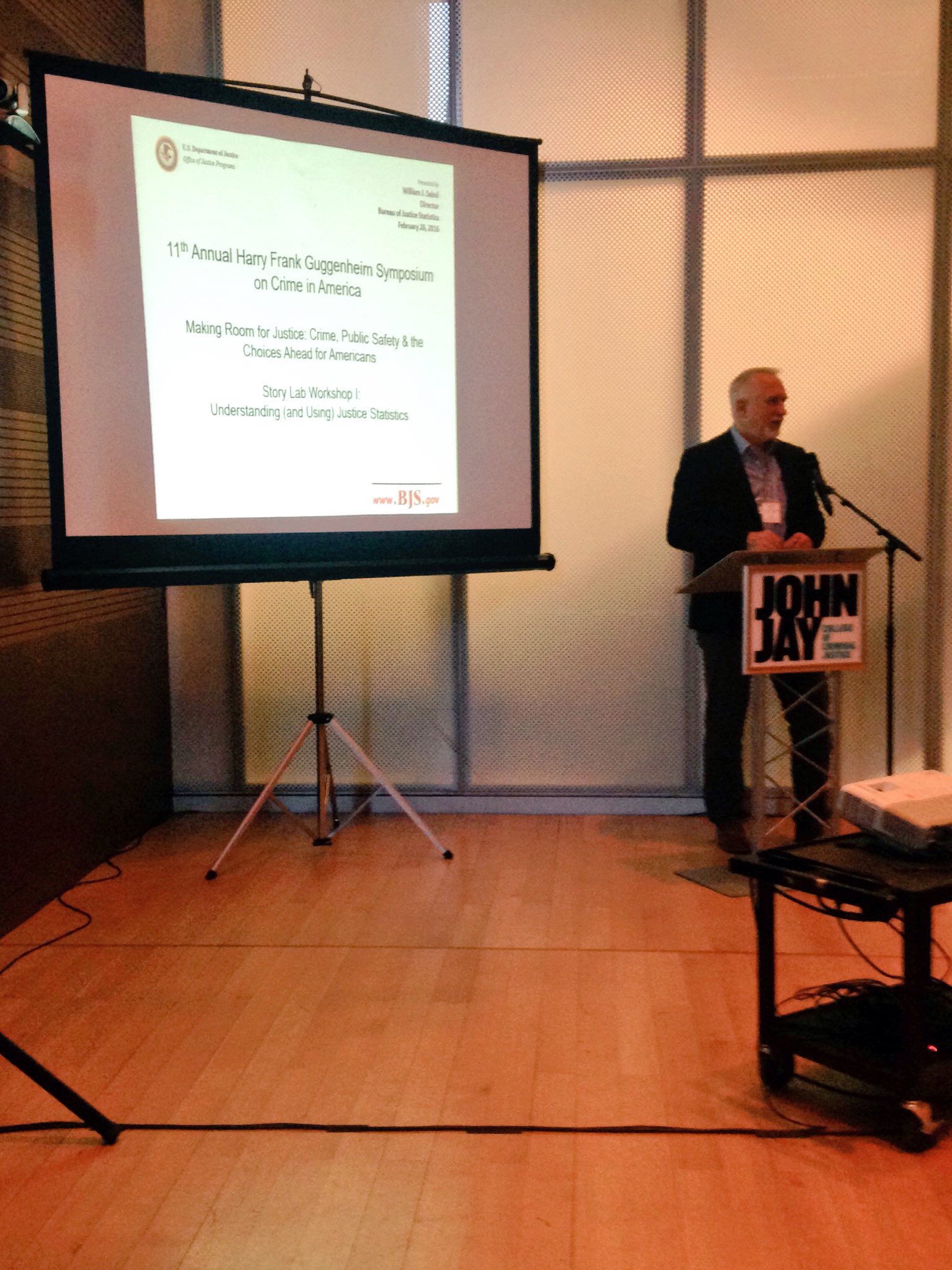
As debates continue over strategies for reforming the U.S. criminal justice system, experts across the public sector, academia and business convened for the 11th annual John Jay/Harry Frank Guggenheim Symposium on Crime in America at John Jay College of Criminal Justice. This year’s symposium took place on February 25th-26th and hosted prestigious journalism fellows who explored the unique challenges of reforming the criminal justice system as the nation heads into a presidential election year. The event was co-sponsored by the Pew Safety Performance Project and the Quattrone Center For the Fair Administration of Justice.
Keynote speakers included Jane P. Bowers Provost and Senior Vice President for Academic Affairs of John Jay College, Hon. Ras J. Baraka, Mayor of the City of Newark, Hon. Karen Freeman-Wilson, Mayor of Gary Indiana, Hon. Jed S. Rakoff Judge for the Southern District of New York to name a few. The event also featured a total of six panels such as:
- The Road Ahead: The View from the Cities
- Criminal Justice Trends: Crime wave? What Crime wave?
- Sentencing and Public Safety
- Bridging the Divide: Race, Community and Safety/Policing Relations,
- Coping a Plea: Why the Innocent Go to Jail
- Task Force on 21st. Century Policing
Experts included, for instance, Alfred Blumstein, Professor of Urban Systems and Operations Research at Carnegie Mellon University; Adam Gelb, Director of the Pew Public Safety Performance Project; and Scott Thomson, Chief of the Camden County Police Department. Speakers and participants pointed to the importance of media attention to #CrimeInAmerica and the need to increase community activism at a moment of bipartisan consensus for reforming the criminal justice system.
Workshop on the Supply of and Demand for Justice Statistics
Two Story Lab Workshops were featured in the event. The first focused on Understanding and Using Justice Statistics, and the second on Media Coverage of Massive Shootings. The former, on Understanding and Using Justice Statistics was facilitated by Ted Gest, President of Criminal Justice Journalists, and presenters Janet Lauritsen, Curators’ Professor University of Missouri-St.Louis and William Sabol, Director of the Bureau of Justice Statistics (BJS), was particularly relevant to GovLab’s current work around data-driven criminal justice reform. During the session, Lauristen and Sabol provided a diversity of insights about data collection and the functions of the BJS, and participants. Specifically the consequences that arise because the UCR works with more than 18,000 city, university and college, county, state, tribal, and federal law enforcement agencies who voluntarily report data on crimes brought to their attention.The BJS sees these data as “critical to federal, state, and local policymakers in combating crime and ensuring that justice is both efficient and evenhanded.”
The growing demand among journalists and the general public to better understand crime data and trends was emphasized during the workshop. Much of this discussion focused on the country’s two central data reporting systems: the Federal Bureau of Investigation’s (FBI) Uniform Crime Report (UCR) and the National Crime Victimization Survey (NCVS). Additionally, participants explored the mutually beneficial collaboration between States and Federal agencies as a means to address some of the Bureau’s aging data collection processes and tools in light of current and emergent technologies and the information ecology.
Sabol provided detail and context regarding the BJS’s data collection activities, highlighting the U.S. Census Bureau as the main collector of data. The BJS shares information and statistical programs with the Department of Justice and works closely with the Federal Bureau of Investigation (FBI) UCR and the National Incident-Based Reporting System (NIBRS). BJS Federal Justice Statistics Program also collects data from other Federal agencies, including the Executive Office for U.S. Attorneys, the Administrative Office of the U.S. Courts, the U.S. Sentencing Commission, and the Federal Bureau of Prisons. BJS’s statistical information has evaluative uses and can inform policy makers at different levels and agencies across the Nation.
The efforts described are consistent with the BJS mission to “collect, analyze, publish, and disseminate information on crime, criminal offenders, victims of crime, and the operation of justice systems at all levels of government.” Better data collection and sharing practices may help better understand many aspects of criminal justice phenomena and promote the public debate on the complex 21st-century challenges of law enforcement and public security. Another important insight is to capitalize the opportunities for open source data to measure crime and understand trends, recognizing there is increasing need for innovation and modernization of tools.
Data Driven Criminal Justice Innovation Project at The GovLab
The GovLab participated in the event as part of a yearlong research project, funded by the Laura and John Arnold Foundation, to analyze and document how data flows through the criminal justice system and identify policy and legal barriers to effective data sharing among agencies, and between agencies and researchers. In tune with the research agenda of The GovLab, we are also interested in learning about strategies that enable greater collaboration between government and the research community, with the goal of better understanding how individual-level data can be shared in responsible ways, among practitioners and researchers, to increase public safety, reduce mass incarceration and accelerate innovative projects.
In particular, we are exploring:
- The data collection process as an offender moves through the adult and/or juvenile systems from detention to sentencing and other forms of supervision;
- The process by which County and State level agencies share data with researchers; and
- The process by which agencies get data back from private sources.
Armed with this type of knowledge, The GovLab hopes to enable the type of experts convened at the Symposium on Crime in America to gain a new capacity for tracking crime trends and extending their analytical capabilities related to our criminal justice system, as well as emphasizing the need to have robust data collected at each stage from arrest to incarceration, parole and probation.
Further information about The GovLab’s criminal justice data project can be found here.
#CrimeInAmerica
