
Jean-Claude Burgelman: How to Support a New Era of Scientific Research
07 January 2015
At the latest installment the Ideas Lunch series, the GovLab hosted Dr. Jean-Claude Burgelman, the Head of Unit C2, DG Research and Innovation of the European Commission. The talk centered on the changing academic and scientific research market, in the Web 2.0 era. He also provided some of his thoughts on his most recent project within the European Commission, a public consultation initiative, “Science 2.0: Science in Transition.”
Burgelman’s talk built o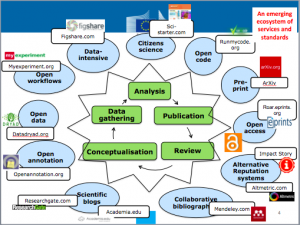 ff of past work he has done mapping the emergence of a Science 2.0, and the role that Web 2.0 technologies are playing in the development of science. New tools and technologies, like open source, open access journals, and blogs, are changing the model of scientific every stage – in data gathering, publication, review, and conceptualization.
In his own work, Burgelman makes the point that science is becoming more open and collaborative, as well as more data intensive. These trends are beginning to impact existing academic and scientific institutions, such as their funding structures, hiring processes, and even through the type of education being sought out by students.
Rather than see these changes as threatening, Burgelman urges policymakers and academics to acknowledge that a more open science has the potential to foster more accountability, and more reproducibility.
Burgelman does warn readers in his paper published on the open access journal First Monday, there are potential negative outcomes of this increased openness. A new reliance on online tools, such as Academia.edu, Mendeley, or ResearchGate, blog views, and social media mean a different set of metrics has the potential to determine the success and potential impact of scientific research. And members of the public and members of the scientific community, have different criteria for what constitutes “good” science. How institutions will respond to this new trend will become pivotal in resolving this debate in the future.
Burgelman’s talk resonated with many of the policymakers and academics in attendance that were keen to understand how government bodies, such as the European Commission, are responding to changes in this field. Discussions centered on how Science 2.0 would be governed, the relationship between public and private enterprises in funding research projects, and the development of new metrics to assess the quality of scientific research.
Some key takeaways from Burgelman’s discussion:
- Social, political and technological changes are leading to a science and research paradigm that is more ‘open.’
- Science will continue to be more open, through the increased popularity and influence of open access journals, and other ways of evaluating research through software like ResearchGate, Mendeley and others.
- Opening science creates a scientific paradigm that has the potential to be more productive, reliable and reproducible.
- We need new metrics to evaluate scientific impact, which will become important in the evaluation of science and in funding decisions.
The targeted public consultation period of the project closed on September 30, 2014. The draft policy brief led by Dr. Jean-Claude Burgelman’s team is still open for comments.
Further Reading:
- Science 2.0: Draft Policy Brief
- The European Commission ScienceInTransition Website
- Science 2.0 (change will happen…), First Monday
