
Help Build the Open Governance Knowledge Base
13 November 2013
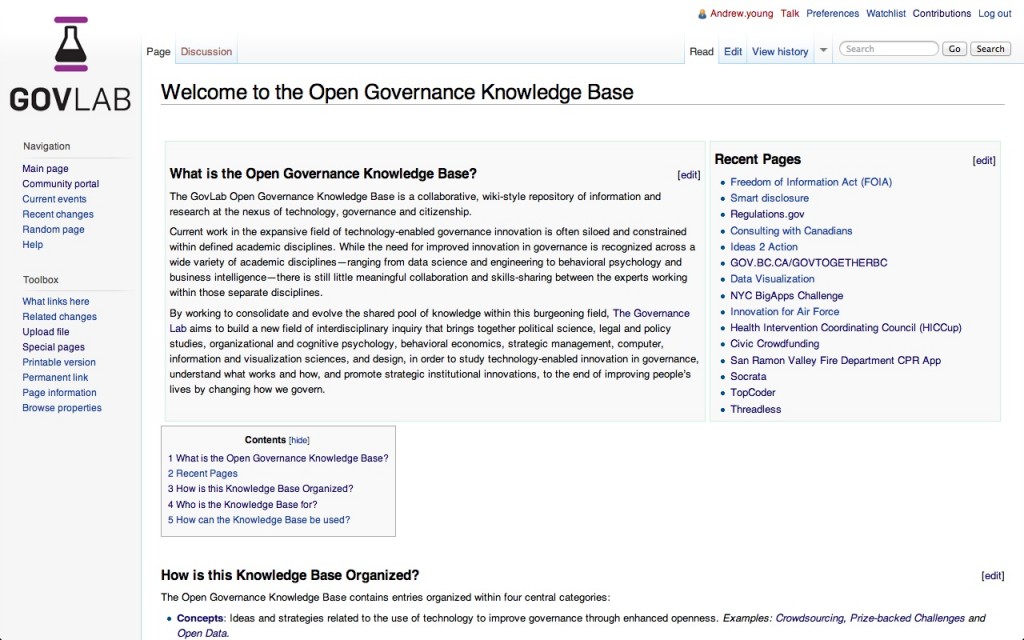 In its continued efforts to organize and disseminate learnings in the field of technology-enabled governance innovation, today, The Governance Lab is introducing a collaborative, wiki-style repository of information and research at the nexus of technology, governance and citizenship. Right now we’re calling it the Open Governance Knowledge Base, and it goes live today.
Our goal in creating this collaborative platform is to provide a single source of research and insights related to the broad, interdiscplinary field of open governance for the benefit of: 1) decision-makers in governing institutions seeking information and inspiration to guide their efforts to increase openness; 2) academics seeking to enrich and expand their scholarly pursuits in this field; 3) technology practitioners seeking insights and examples of familiar tools being used to solve public problems; and 4) average citizens simply seeking interesting information on a complex, evolving topic area.
While you can already find some pre-populated information and research on the platform, we need your help! The field of open governance is too vast, complex and interdisciplinary to meaningfully document without broad collaboration.
Here’s how you can help to ensure this shared resource is as useful and engaging as possible:
- What should we call the platform? We want your title suggestions. Leave your ideas in the comments or tweet them to us @TheGovLab.
- And more importantly: Share your knowledge and research. Take a look at what we’ve posted, create an account, refer to this MediaWiki formatting guide as needed and start editing!
Right now, we’re using the following four broad categories to organize entries. You can find suggested templates for each at the linked category landing pages.
- Concepts: Ideas and strategies related to the use of technology to improve governance through enhanced openness. Examples: Crowdsourcing, Prize-backed Challenges and Open Data.
- Tools and Innovations: Specific products, platforms, services, or advances within the networked/connected technology space that enable or inspire efforts to open governance. Examples: Socrata, TopCoder and Stack Exchange.
- Case Studies: Descriptions of the use of technology by a specific organization or entity to improve openness, decision-making, or other functions related to open governance. Examples: Data.gov, Regulations.gov and ICANN.
- People and Organizations: Individuals and organizations who have contributed to the research space, led substantial efforts in intellectual understanding, developed significant technical advances, or used technology in an innovative way to improve governance. Examples: Beth Simone Noveck, Todd Park and Open Government Partnership.
In the interest of being as useful and comprehensive as possible, the platform is open to submissions on any and all topics related to the field. To learn more about the work that the GovLab is doing, check out the entries on our three core lines of inquiry, or levers of open:
- Smarter Governance: Getting Knowledge In – Institutions seek input from lay and expert citizens experts to inform how they make decisions. Example: An international governance body enlists a global network of scientists to inform its strategies on climate change.
- Open Data Governance: Pushing Data Out – Institutions publish the data they collect so that citizens can analyze and use this information to detect and solve problems. Example: A national government releases hospital infection records, enabling developers to create a hospital safety search engine that allows parents to make an informed decision about where to take their sick child.
- Shared Governance: Distributing Responsibility – Institutions delegate responsibility to citizens, or empower citizens to develop solutions themselves. Example: Legislatures from New York City to Seville, Spain to Porto Alegre, Brazil, are experimenting with participatory budgeting, the process by which control over millions of dollars of budgetary spending to citizens instead of professional politicians and bureaucrats.
