

Adolescent Mental Health
22 July 2020
co-authored by Jennifer Requejo and Liliana Carvajal
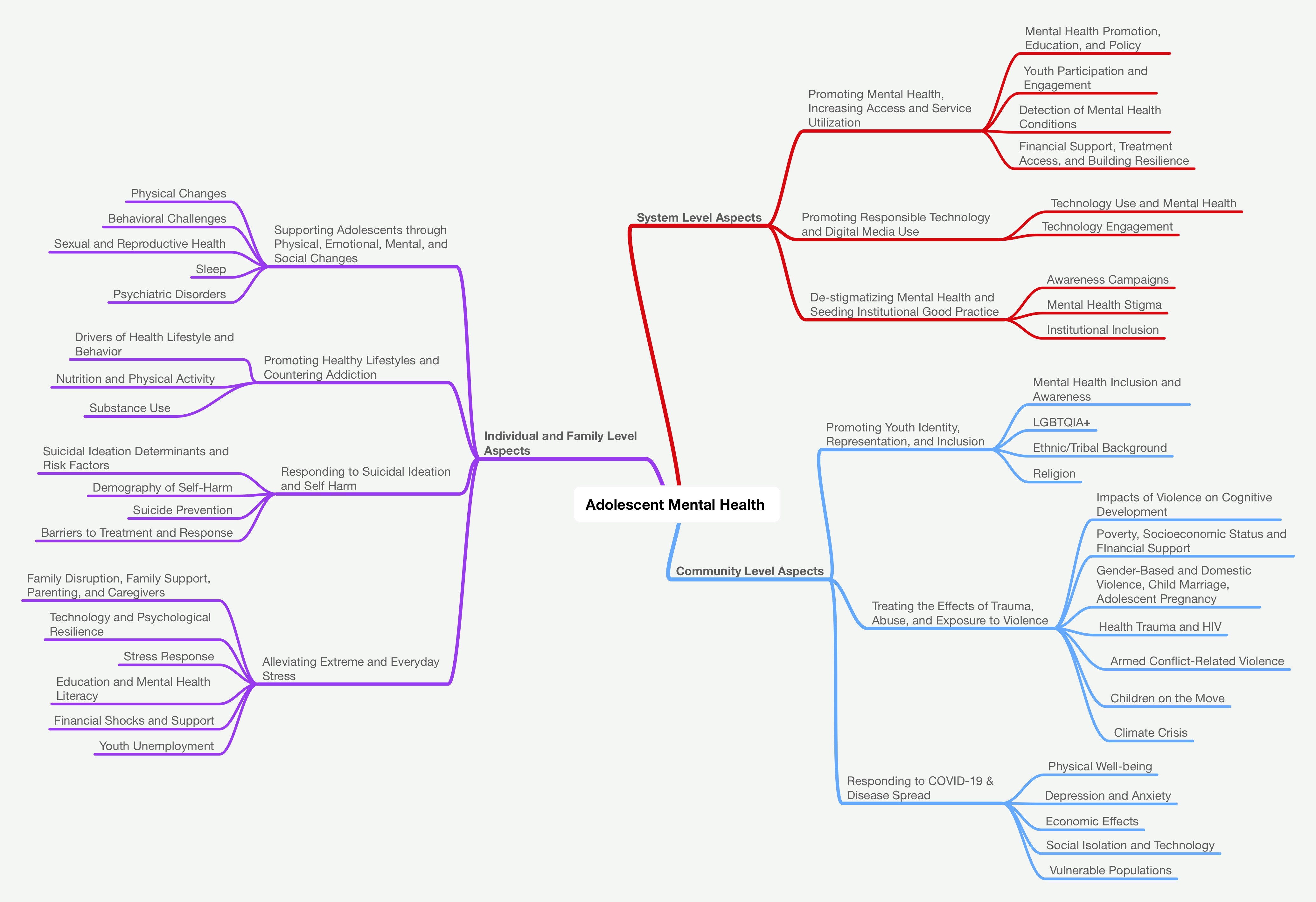
Adolescence is a unique stage of life. The brain undergoes rapid development; individuals face new experiences, relationships, and environments. These events can be exciting, but they can also be a source of instability and hardship. Half of all mental conditions manifest by early adolescence and between 10 and 20 percent of all children and adolescents report mental health conditions. Despite the increased risks and concerns for adolescents’ well-being, there remain significant gaps in availability of data at the country level for policymakers to address these issues. In June, The GovLab partnered with colleagues at UNICEF’s Health and HIV team in the Division of Data, Analysis, Planning & Monitoring and the Data for Children Collaborative — a collaboration between UNICEF, the Scottish Government, and the University of Edinburgh — to design and apply a new methodology of participatory mapping and prioritization of key topics and issues associated with adolescent mental health that could be addressed through enhanced data collaboration. The exercise involved 70 experts from around the world, including youth advocates, who examined and prioritized — during two virtual workshops — various aspects of adolescent mental health leveraging a topic mapping. The results of these discussions will be used to help inform a consensus-based data and research agenda for adolescent mental health with a particular focus on measurement and monitoring. The workshops complement The GovLab’s partnership with UNICEF on the Responsible Data for Children Initiative (RD4C) and previous collaborations focused on the use of data to provide actionable insight on gender and urban mobility and suicidal ideation among youth. Toward a participatory and prioritization mapping methodology Our methodology included three phases: a topic mapping exercise; a workshop; and a subsequent sourcing of priorities through a survey. Topic Map Graphic and Topic Map First, The GovLab and UNICEF designed a topic map on adolescent mental health. This work relied on The GovLab’s previously developed rapid-research methodology, an approach to research that allows individuals to rapidly develop a systematic review of the issues associated with a topic for agile and creative problem-solving. This approach is also a staple of The GovLab’s 100 Questions Initiative, an effort to map the world’s 100 most important questions that could be answered if data science were used in a responsible manner. The Adolescent Mental Health Topic Map identified 10 areas where measurement and monitoring can improve understanding of adolescent mental health. Though this scan provided a basic overview of common research avenues, it was not meant to be entirely comprehensive. The topic map framed along three levels of practice: systems-level aspects, how adolescent mental health affects and is affected by laws, power structures, and technological innovations; community-level aspects, how adolescent mental health affects and is affected by norms, attitudes, behaviors, and practices of society; and individual and family-level aspects, referring to the effect adolescent mental health has on individual people. Each level of practice included several major topics selected from peer-reviewed literature. Systems-Level Aspects:
- Promoting Mental Health, Increasing Access and Service Utilization: Past surveys suggest that many adolescents do not receive adequate mental health care. The reasons for this vary, though exorbitant costs and lack of service availability are limiting factors. Participants discussed how data-driven work on this issue might focus on mental health promotion, preventative work, and improved detection of mental health conditions.
- Promoting Responsible Technology and Digital Media Use: Cognitive development and mental wellness is intertwined with the internet, social media, and smart devices that allow adolescents to remain connected with their peers. While most are aware of the importance of these tools, understanding of their effects remains nascent. The topic map discussed how data might be used to interrogate the effects of technology on mental health, how mental health affects the use of technology, and the role technology can play in expanding mental health services.
- Destigmatizing Mental Health and Seeding Institutional Good Practice: Misconceptions surrounding the cause and management of mental disorders can lead to stigmatization of individuals with such issues. The topic map reviewed whether data could be used to raise mental health awareness among adolescents, embed inclusive practices in institutions delivering services to adolescents with mental health needs.
Community-Level Aspects:
- Promoting Youth Identity, Representation, and Inclusion: Adolescence is a formative period of self-discovery and exploration. Many seek guidance from their families, peers, and those in their ethnic, religious, or tribal group, while others assert their independence. Still others become aware of their sexual orientation or gender identity. The work reviewed whether data can be used to foster inclusion and combat bullying, support the needs of LGBTQIA+ adolescents, further address challenges that might be experienced by those in an ethnic or tribal group, or support those in mainstream and minority religious groups.
- Treating the Effects of Trauma, Abuse, and Exposure to Violence: Many adolescents suffer traumatic events that can result in long-term effects on mental health. Understanding these events and their consequences can be integral to preventing them or providing services to mitigate their psychological impact. Notable data-driven research could focus on the negative impacts of violence (including gender-based and domestic violence), poverty, health trauma, armed conflict, displacement, and the climate crisis on cognitive development.
- Responding to COVID-19 and Disease Spread: The novel coronavirus disease (COVID-19) is a global, unprecedented modern health crisis. Yet, there is limited research on how adolescents emotionally and mentally respond to coronavirus-related confinement or how it is affecting their behavior. More understanding is needed about the relationship between adolescent mental health and COVID-19-related changes in their lives.
Individual and Family-Level Aspects:
- Supporting Adolescents through Physical, Emotional, Mental, and Social Changes: Adolescence can be a unique and unpredictable period. Teenagers undergo physical and hormonal changes that influence how they see themselves and how they interact with their peers and others. Individuals may also experience new and unfamiliar emotions for the first time that affect their mood or behavior. Data could play a role in supporting professionals on the physical changes that adolescents go through, the behavioral issues they might encounter, issues concerning sexual health or sleep, and responses to various psychiatric disorders that often emerge during adolescence.
- Promoting Healthy Lifestyles and Countering Addiction: Self-exploration in adolescence can coincide with experimentation with drugs, alcohol, and addictive behaviors such as gambling. As these behaviors can have a negative impact on brain development, some governments have made it a priority to counteract these behaviors and promote healthier lifestyles. Data-driven research on this topic could explore patterns of substance use and abuse and drivers of the adoption of healthy lifestyle among adolescents.
- Responding to Suicidal Ideation and Self-Harm: In addition to other challenges, adolescents have higher rates of suicidal and self-harming behavior than other age groups, making it a leading cause of death for young people. In efforts to prevent suicide or injury, the topic map noted how researchers might use data to study the determinants of self-harm and suicidal ideation, help high-risk individuals, identify prevention strategies, and better care for and respond to those following incidents of self-harm.
- Alleviating Extreme and Everyday Stress: Adolescence, as a time of major physical, social, and psychological change, can be a time of heightened stress-induced emotional responses. The demands of educational systems, work, and other obligations can lead to high or sustained levels of stress for adolescents. As such, the topic map discussed how many policymakers and researchers have sought to help adolescents cope with family disruption, educational or financial difficulty or otherwise foster psychological resilience or healthy responses to stress.
Workshops After creating this mapping and sharing its contents with the Data for Children Collaborative, we shared the document for wider validation. Relying on UNICEF’s international network, we solicited feedback from 70 international experts and youth advocates of adolescent mental health. We conducted two virtual workshops in order to receive feedback and inputs in a participatory manner. Guided by UNICEF and The GovLab’s staff, the participants talked about the items raised in the topic map, as well as additional topics for consideration. Though only a start, the topic map provided a useful framework for the experts to collectively assess the various issues and priorities associated with adolescent mental health. Several of the participants focused on the need to better center certain aspects of mental health. Throughout the conversations, participants noted the importance of certain issues—such as education, technology, labor participation, the need for financial support—and how these items had cross-cutting impacts. Other participants thought the topic map could be expanded to include new dimensions and domains. For system-level aspects, for instance, individuals noted the serious impact COVID-19 would likely have on adolescent mental health. In the weeks following the workshop, The Lancet published a piece noting the significant impact COVID-19 would likely have on child well-being. Separately, on individual and family-level aspects, several experts talked about the need for dedicated topics on barriers and facilitators to service access, parenting, peer groups, and youth engagement. They also noted the need for better coverage of matters such as adolescent pregnancy, care services, child marriage, disability, education, and migration. In short, the workshop facilitated a more participatory mapping and sophisticated deliberation of the topics. It also enabled the creation of a topic map validated by a community of experts. Sourcing priorities Finally, following this workshop, UNICEF and The GovLab sourced priorities through a survey sent to the 70 participants. This survey, comprising eight questions, gave attendees the chance to provide feedback and further inputs by indicating which topics they consider most important and which areas of the topic map need further improvement. This work, which is ongoing, will be used to inform a research agenda for UNICEF in the area of adolescent mental health measurement. Importantly, this research agenda will identify which areas around which UNICEF should pursue data collaboratives—a new form of collaboration, beyond the public-private partnership model, in which participants from different sectors , in particular companies , exchange their data to create public value. Establishing data collaboratives is integral to addressing some of the real and serious gaps in existing, available data sources. Takeaways The event led to three main takeaways. First, the topic mapping allows participants to deliberate and prioritize the various aspects of adolescent mental health in a more holistic manner. Unlike the “blind men and the elephant” parable, a topic map allows the participants to see and discuss the interrelated parts of the topic, including those which they might be less familiar with. Second, the workshops demonstrated the importance of tapping into distributed expertise via participatory processes. While the topic map provided a starting point, the inclusion of various experts allowed the findings of the document to be reviewed in a rapid, legitimate fashion. The diverse inputs helped ensure the individual aspects could be prioritized without a perspective being ignored. Lastly, the approach showed the importance of data initiatives being driven and validated by those individuals representing the demand. By soliciting the input of those who would actually use the data, the methodology ensured data initiatives focused on the aspects thought to be most relevant and of greatest importance. The workshop and survey help to identify areas where data collaboration can provide the most value. The GovLab and UNICEF welcomes broader input on how to refine and improve this mapping, suggestions to address any gaps in analysis, as well as expressions of interest from readers interested in exploring the application of the topic map in their work.
