
Teaching and Courses @ The GovLab, Fall 2014
02 September 2014
This Fall, members of the GovLab team are teaching courses at the intersection of governance, technology and society, while experimenting with new technologies and teaching methodologies. Here are some of the courses being taught this semester, with links to more details.
Courses
Internet Governance: Mapping Internet Governance Principles, Policies, and Practices – taught by Stefaan Verhulst, GovLab Chief of R&D.
This course covers the principles, institutions, and policies that seek to govern the Internet globally, along with the narratives associated with Internet Governance.
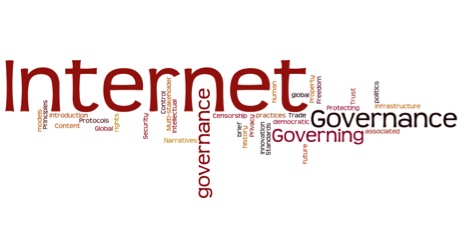
At the GovLab, we aim to tackle complex issues of governance and explore the redesign of institutions through technology. The Internet has become an essential platform and engine for economic development, social justice and the protection of human rights. At the same time, the issue of global Internet governance raises challenging questions, including: where the control of the Internet should reside, what guiding principles should be used in governing the Internet, and who should take part in the policymaking process? Students will explore prominent narratives and issues, such as the concept of architectural openness, the promotion of Internet freedom, and the governance models that drive decision-making related to the Internet. Through weekly discussions and the tracking of developmental shifts, this course seeks to provide insight into the possible future of the medium. Students post and discuss new developments in the field on the class blog, which you can read here.
This course is given at the Department of Media, Culture, and Communication at NYU Steinhardt.
Solving Public Problems with Technology – taught by Beth Noveck, Director of the GovLab.
This program offers the knowledge, tools, tactics, and networks to help change agents create actionable public interest projects that improve people’s lives.
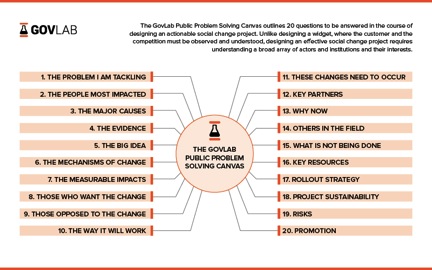
Solving Public Problems with Technology is a hands-on learning and mentoring program designed to help you design and implement solutions to public interest problems using civic technology. The course enables you to take advantage of the latest innovations in open and participatory problem-solving, including the application of open data, crowdsourcing, expert networks and systems, game mechanics, and prizes. Geared to the purpose-driven participant (both individuals and teams) passionate about a problem, Solving Public Problems helps you develop a project from idea to implementation. The program focuses exclusively on the public interest and on projects that work with real world institutions and partners, such as agencies and NGOs, to develop more effective and scalable initiatives.
Through coaching, rapid prototyping, collaboration and repeated presentation, you will develop project-related skills such as how to sharply define a problem, design for citizens, overcome legal barriers and pitch projects to risk-averse officials and politicians. In the process you will be joining a growing network of likeminded peers who also working with civic tech to address hard public problems.
The program is available for credit at NYU, MIT Media Lab, and Arizona State University. Non-credit online participants who complete the program receive an authenticated Certificate and Badge. For successful participants the program will serve as a gateway to opportunities to compete for a range of Fellowship and funding opportunities, including from the Knight Foundation, the D-Prize, the GovLab and more.
The deadline for non-credit applicants to submit applications is September 4. Apply here.
The program will also be streamed live online.
